

Scoring my 2025 predictions
Countdown to Christmas and I've had a rake through what I predicted earlier in the year.

Here is the first of two posts I’m sending this week, before going offline(ish) until 2026, when the first newsletter back from the Christmas break will be January 7th.
I’m sure your inbox and trade publications are flooded with all sorts of looks back at 2025 and predictions for 2026. And with a huge amount of originality, these two posts are no different.
Back in January, rather than make specific predictions I had a go at the trends which could impact the TV and film production markets over 2025. So I thought I’d revisit the list, and see whether in the end they turned out to be a big deal or a damp squib.

Trend 1: YouTube and YouTubers continue to gobble attention
The two trends I said we should look out for were:
The explosion in the number of creators and the share of audience attention that goes to their channels instead of professionally produced TV is likely to continue.
Will 2025 see more TV companies and individuals successfully make this transition to become the new generation of TV/creator hybrids?

So yes, 2025 was the year when TV finally pulled into sharp focus the share of viewing time that YouTube has been growing. However, worth saying though that amidst all the noise about YouTube, that its share of TV set viewing in the US has been stagnant for most of the year at around 12 - 13%. This is in part due to the seasonal strength of the autumn TV schedule, but also I can’t help but wonder that the ‘everything platform’ nature of its offering might actually be a bit of a turnoff for certain demographics - perhaps the paradox of choice in action. Key here is to remember that the world of YouTube is hugely diverse - so how popular and widespread its usage depends on all sorts such as different territories and different demographics. In general, we’ll have to see if this flatlining of growth for US connected TV viewers is just a blip or actually a trend that will carry on into 2026 - more on that in my next post.
As for whether we are seeing more TV companies and individuals make this transition to TV/creator hybrids. It has been notable that many studios and groups have invested in new direct-to-consumer content teams - Sony and Fremantle to name but two. Similarly, we have also increasingly seen TV companies invest in their own DTC operations - say Middlechild launching a new Alan Titchmarsh YouTube channel, or WoodCut’s continued investment in their IP creation and exploitation network, Uncut. We’ve also seen lots of individuals invest their own time and money into a digital first production - such as Jon Stahl’s comedy series.
Privately, I’ve had many individual freelance TV producers/directors/production executives get in touch because they are looking to grow into this space, by taking their genre expertise built up over years in the TV industry and launching their own channel and creator brand. However perhaps some have interpreted this as needing to ‘give up’ on their TV careers, when actually in a hybrid world in theory at last they should be highly skilled at operating across both TV and online platforms.
Trend 2: Creator economy continues to mature
These were my key trends to keep your eye on:
the further emergence of creators as individual media empires or brands
whether creators can continue to successfully bring and sustain their online audiences to TV or streaming shows - ones to watch will be the numbers on Amazon’s Beast Games once the dust has settled, plus Netflix’s deal with the Sidemen
how successful creators shift from flogging low value ‘merch’ to launching quality products that can compete with top retail brands
will advertisers put pressure on YouTube to improve its advertising experience in comparison with TV (Alan Wolk is worth reading on this point: Once More Into The Breach: Our Fearless Predictions For 2025)
whether revenues are enough to sustain the number of individuals entering and competing in this sector
the risk of burn out because of the demands of algorithmic publishing
how the various platforms deal with the growing trend of get rich quick and disinformation channels.
Where to start with this one? In hindsight, putting all the seismic issues into one prediction was a bit silly, as I could write a thesis on each. Covering IP, business models, the ad market, disinformation, revenue versus profitability, investment and the exhausting hamster wheel that can be being creator….
However, I’ll pull out a couple of points here, and then will write more in my next post which is a look forward to 2026:
Streamers and platforms have been doing all sorts of creator deals such as Mark Rober with Netflix, however we should be careful in splitting out those that are acquisitions and those which are commissions.
The numbers for both Beast Games (Amazon) and Sidemen’s Inside (with Netflix) were less than stellar, and while there is a second series of Beast Games (was it a multi-series deal originally?), the MD of Sidemen recently left the impression that the next series of Inside might be looking for a home other than Netflix. This is all part of that maturing of the market, where creator operations stop being seen as otherworldly mythical beasts and instead are evaluated against the same criteria as everyone else.
Creators launching quality products - the move up the value chain has continued this year, with various mega creators launching their own streamers plus a whole range of products and services. While this can be interpreted as an expansive move, it is also about diversification and reducing the dependence on YouTube’s AdSense income. One to note for TV producers.
The ad market - forget the streaming wars, the real story of 2025 (and into 2026) is the battle between a whole host of players for the TV and digital ad market which is both a global and local battleground. This is here where YouTube is trying to position itself as ‘TV’, and where the TV industry ended the year flexing its muscles and seriously pushing back. The reality of YouTube being a place where ads can one minute be sitting next to a high quality piece of content and the next, alongside something far less desirable is a challenge inherent in a user generated environment, although YouTube clearly is doing a whole lot under the hood to try to minimise these risks.
Disinformation and get rich quick channels - this has turned into a huge issue that will only get bigger with the widespread availability in gen AI tools. Increasingly, platforms are getting tough on certain types of channels, however they still struggle to routinely clamp down on content that is just plain editorially false, as they have long avoided making that type of judgement. YouTube has ended the year with many angry creators who have had their channels banned, believing they have been victim of an over zealous or rogue AI moderation system. YouTube conversely has said their systems are operating as expected.
Last point on all of this - Entertainment Strategy Guy has done a sterling job of pouring cold realism on the hype around many creator ‘empires’, especially looking at amped-up valuations that skirt over the chunky losses sustained by certain creators.

Trend 3: Compliance and regulation
I suggested that a key area for 2025 would be around regulation and compliance, which has a knock on to production companies, broadcasters, online content businesses and more. I highlighted a whole host of areas where big tech is facing a whole number of legal and regulatory issues, including disinformation, child safety, antitrust, the ownership of TikTok plus the general user generated content environment. All against the obvious backdrop of a new presidency with its own agenda and priorities.
All of these issues were apparent throughout 2025, however perhaps not in the way predicted. So, for example, the new Online Safety Act came into force in the UK, the ban of children under 16 on social platforms became law in Australia, while the ownership of TikTok continues to roll on with a new date being given in January for the owner to divest or face a ban in the US.
This issue of compliance and regulation especially around disinformation and child-safe content and environments (as well as the significant discrepancy between public service broadcasters and tech platforms like YouTube) is not going to go away anytime soon. What is very hard to predict is what moves all the players will make - from governments, the EU, regulators, rival companies as well as users.
Trend 4: M&A for traditional TV networks
There where three types of M&A activity I suggested to watch for:
The completion of the Paramount Skydance deal and what will be the knock on to Channel Five
Who will buy WBD (or which parts of WBD) - suggesting Comcast for the whole company, to Apple for certain assets
Will there be wider acquisitions of the TV market by tech companies.
While obviously Paramount Skydance has started to layoff staff globally, the wider implication of this deal plus whatever happens to WBD is still working its way through into 2026 and possibly beyond. Obviously my Comcast suggestion has proven to be rubbish, ditto Apple for HBO. However, I think this is where my last prediction around tech companies and the wider TV market might carry forward into 2026.
Trend 5: Different strategies to increase time spent within a company’s ecosystem
A big broad battleground involves how various companies are competing to be the (or at least one of the) go-to brands to power more of our lives. As I wrote last year within the context of the streaming wars:
…it isn’t so much about winning the streaming wars and creating profitable video services, rather the bigger war is to own the whole media experience for users across the globe.
Through this lens, you can see how tech companies like Amazon, Microsoft, Apple, Meta and Google are fighting to be the software, hardware and services ecosystem for audiences, as well as consumer electronics brands like Samsung and LG.
Throughout 2025, you could see companies implementing strategies to help them on this front:
Netflix’s deals around video podcasts
YouTube and Netflix pushing in to games
Walmart’s continued investment in Vizio to take a sizeable share of the connected TV market
A little notable mention how quickly things can shift. In January, I wrote:
A slightly tangential example is Bytedance (parent company of TikTok) launching Melolo in Google Play Store, which is a free short form drama app targeted at Southeast Asian audiences, featuring romance, thriller, and costume genres around 10 - 20 minutes long.
Amazing to see how quickly this went from the above description to being the major microdrama trend we are seeing today. As an aside, I wrote an explainer a few weeks ago about the (on paper) appeal of microdrama apps - where users pay to watch the bulk of the series after getting hooked in the first episode. Missing from that description was the sheer cost of marketing many of these apps are spending in customer acquisition and reacquisition (tens of millions if not more), as around 95% of users stop using an app each month - so the company has to pay to entice them back to watch a new series. If you are looking to do a deal with a microdrama app for a show, be conscious of any revenue return being net of marketing and platform costs as a result.
Trend 6: Brands as competitors, commissioners and funders
This has been another area we’ve seen increasing activity - but not quite a the level of regularly funding TV-level series or proper shiny floor shows as desired and anticipated by TV production companies, so that is one area to watch for in 2026.
Last week I wrote about how Pepsi has launched a reality TV series for their YouTube channel.
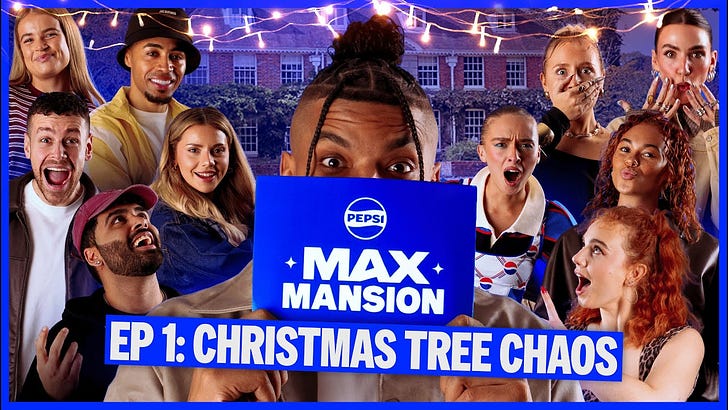
Other brands are likely to further push into the space of commissioning originals for their own channels as well as to distribute to broadcasters and streamers.
And here is a post I wrote earlier with seven examples of brands launching their own TV-like shows - reality, competition, scripted, sketch and more:

So yes, the rise in brands as content businesses continues, especially in a world where emotion, connection and storytelling is crucial in helping sell products and services to consumers.
Trend 7: Innovative funding models for TV and film
There have been more instances of creatives and producers self-financing or finding new distinctive sources of finance for their projects.
Two pick up two trends that I wonder might turn into more in 2026: firstly around equity crowd funding. Although yes of course, Kickstarter and the like have long played a role in helping get projects financed by fandoms, however this idea of equity crowd investment is quite attractive in theory at least - where perhaps a wider bunch of fans might consider putting their hand in their pocket to fund a project or a piece of talent, especially if it means they might get a return at some point in the future.

The second trend is membership clubs, where you can see how the belonging to a tribe or fandom has such emotional value beyond the transactional subscription model where a user gets something in exchange for their sub fee.
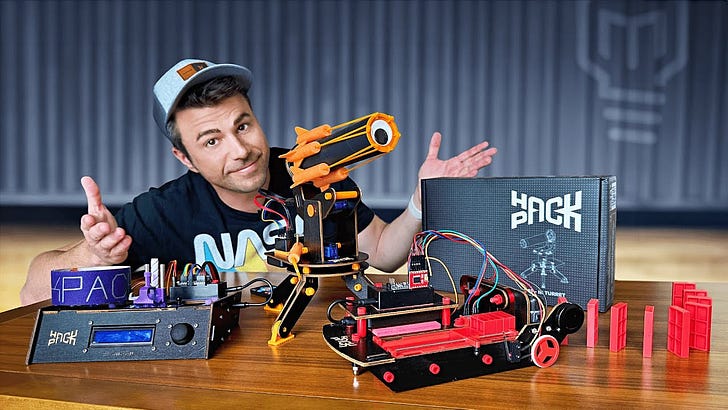
Plus of course, creators doing acquisitions deals with streamers or CTV platforms are running an innovative funding model - where they self-finance their projects (or reinvest their YouTube income back into new series) to then package that up and do distribution deals.
Trend 8: AI - copyright and adoption
The issue around AI and copyright has chuntered on all year, and the sense of frustration from producers and creators is getting more apparent. This is against the backdrop of the growing question marks around the AI market covering everything from reliability of its outputs through to the business model itself might never seeing the predicted returns against the vast sums invested so far. I’ll try to write more about this in the new year, as there is such a notable split between those deeply enthused and passionate about this as a technology, and those who are at best underwhelmed or at at worse openly hostile. And this cuts across all industries, so it isn’t a tech/non-tech split, rather the engineering/computer science sector is divided too into some engineers who are embracing the potential and others who see AI in its current form as being founded on hype.
Despite some deals being done (most notably, Disney’s investment in OpenAI and agreeing licensing for some of its IP), there also are ongoing lawsuits around copyright infringement (for example, Disney again, this time against Google).
It is increasingly clear how the skirting over the copyright issue by AI evangelists especially at TV events is becoming a source of frustration from experienced TV producers seeking assurances over copyright and what protections they have if they use these tools in commercial projects.
Clearly, people want to use many of these tools (and indeed are, in a whole range of specific scenarios), however the lack of clarity around copyright is a major hindrance, and one where perhaps the AI tools that do commercial deals might end up the winners in the longer term, over those who try to scrape for free.
Trend 9: Managing AI content, and dealing with AI slop
My questions around AI slop covered the following:
How will platforms try to crack down on this content either through wack-a-mole or a platform wide approach, will they try to disincentivise these individuals or create a flagging system be developed to alert users to AI material?
What about the volume of disinformation in some of this content? How are users to know which is accurate or harmless AI generated material and which is misleading and false?
Will there be a backlash from advertisers who don’t want to appear next to this type of material?
Will there be an audience backlash against this type of AI material, and will it result in a desire for greater human authenticity, connection and reality?
Over the year, we have see so much activity in this space, and the companies investing heavily in AI tools are in the trickiest of positions of trying to get everyone to use (and pay) for these tools while also running the risk of demonstrating copyright infringement in the creation of slop.
Here is a recent example. Google’s NotebookLM X account shared the following recipe card:
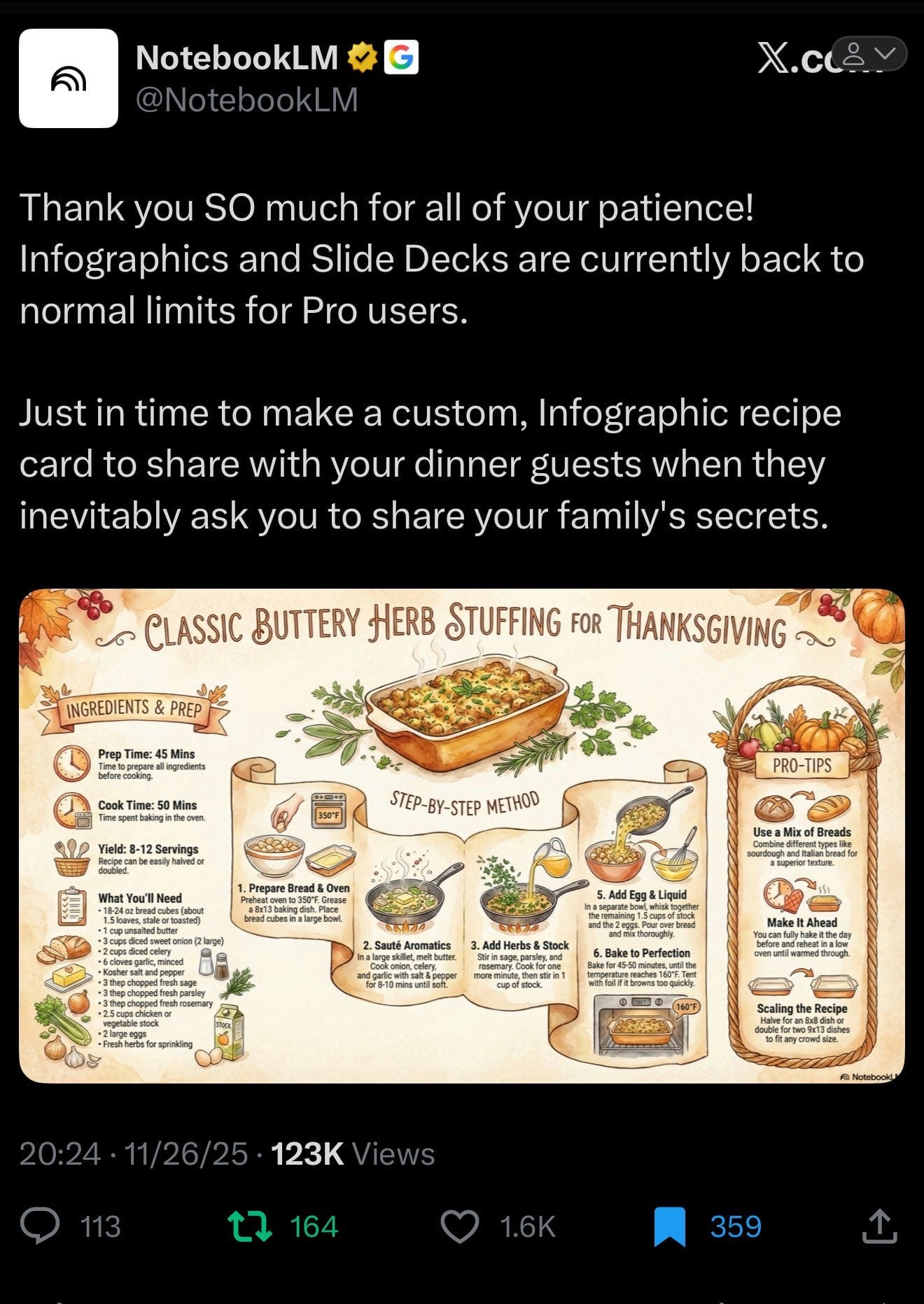
However, a user online asked why they hadn’t credited the recipe owner, especially considering it was nearly identical to the original (although it had introduced typos in the process). Google/NotebookLM went on to delete the original post after a backlash.
Other platforms like Pinterest have announced the ability to turnoff AI content, while YouTube has implemented warning flags onto content it identifies as being generated via AI.
Trend 10: Growth in ad-funded streaming models
I said back in January that the rise in ad-funded viewing is likely to continue and mature well into 2025. With my questions being:
as more ad-funded streaming platforms emerge - Amazon, smaller players like Tubi and obviously YouTube - and the amount of advertising capacity increases, what is the impact on ad revenues for each individual service, platform or FAST channel?
And specifically, as broadcast viewing declines - and so far the revenues from streaming isn’t making-up the difference - how will UK broadcasters deal with the growing competition for share of the ad market from an increasing number of other players?
I have a bigger piece on the ad market to share with you, with a lot more detail on what is happening under the hood. However to make a few points:
Firstly, the UK experience is markedly different to that of the US, and it is most notable around the evolution of free vs paid for TV services. By way of a quick summary, the US evolution looked something like:
paid with ads (cable TV) > paid (subscription streaming services) > paid with ads (subscription streaming services ad tier) > free (streaming services with ads)
Conversely the UK journey went something like this:
free or free with ads (linear TV) > free (catch up and archive streaming services) > paid (subscription streaming services).
So here in the UK, in 2025 we have seen a maturing of the TV and streaming ad market, most notably with the partnership between C4, Sky and ITV launching a premium video ad marketplace.
Secondly, there is a lot of noise coming from those operating direct-to-consumer channels; FAST and YouTube channels that there is a lot of available inventory that isn’t necessarily being filled (or there is downward pressure on CPMs).
I’ve covered some of these issues in more detail in the next post - which are my trends to watch for 2026…. That will be sent on Friday.