


This week I was going to write about the underlying eye-watering costs of AI’s data centres (wait, come back!) but thanks to a great scoop in the Wall Street Journal, I’ve focussed instead on Paramount and Warner Bros. Discovery.
Before getting into that, here is a little plug for a guest spot I did this week on Ted Hope’s Hope for Film publication - it is for independent film makers, and how they can use the internet to reach audiences.

Will Paramount Skydance buy Warner Bros. Discovery?

The Wall Street Journal had a great exclusive yesterday that David Ellison’s Paramount Skydance is rumoured to be looking to acquire WBD. They report this would be a deal to buy all of the current WBD business, rather than wait for it to be split into two next spring and then end up in a bidding war with potential other buyers such as Apple or Comcast for the best assets. The share price for WBD went up 37% at this news.
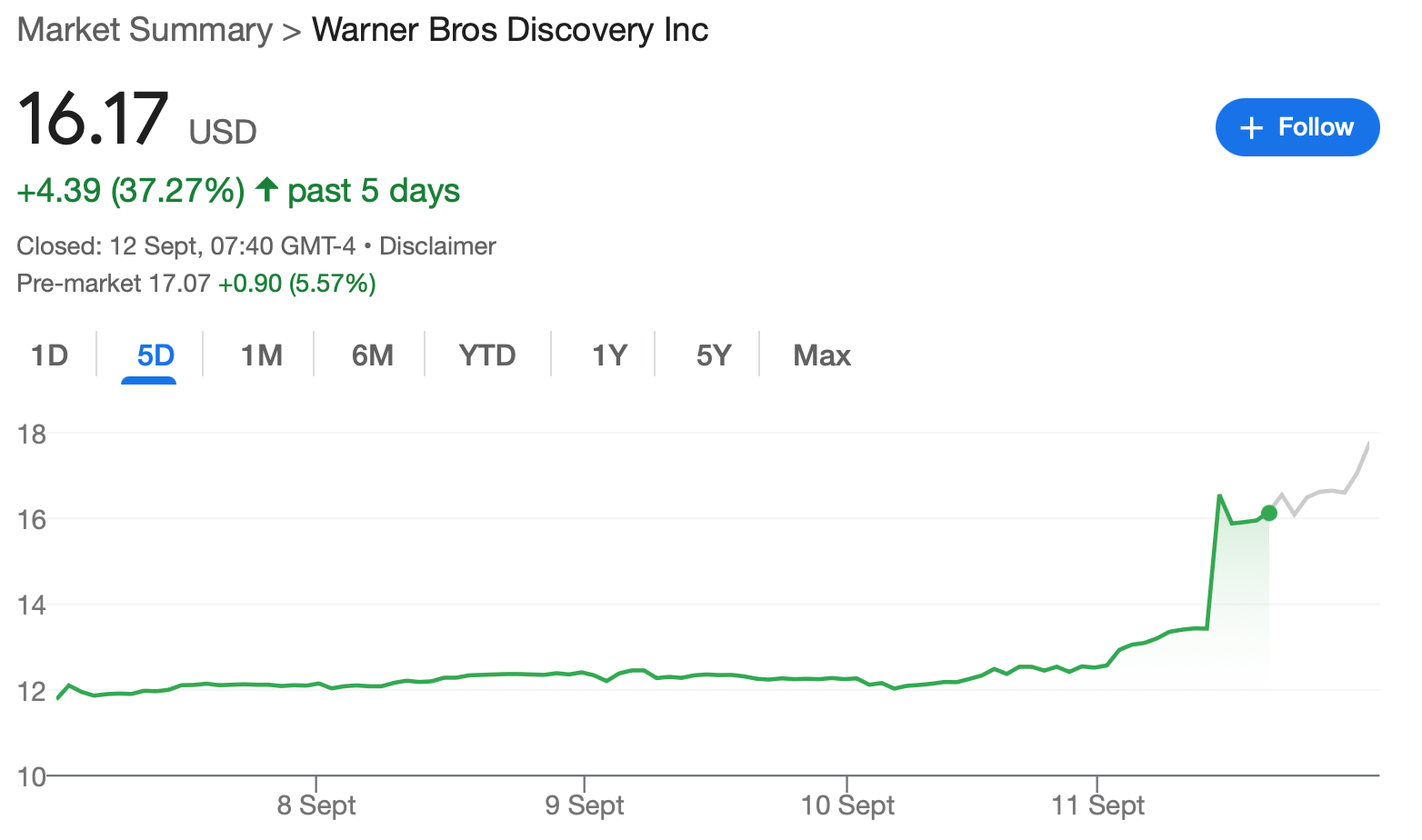
The New York Times said:
Mr. Ellison is interested in acquiring the entire company, in line with his strategy of doubling down on both streaming and traditional TV, the people with knowledge of the plans said. The bid would be made mostly in cash.
A deal to acquire Warner Bros. Discovery would be costly. The company is worth $41 billion and has $35 billion in debt, remnants of the 2022 merger that brought it to life. But the Ellison family has the means: Mr. Ellison’s father, Larry, is a co-founder of Oracle and one of the richest men in the world, with an estimated net worth of $383 billion, according to Bloomberg.
Wall Street Journal: Paramount Skydance Prepares Ellison-Backed Bid for Warner Bros. Discovery
New York Times: Paramount Plans Bid for Warner Bros. Discovery
There are numerous hurdles to this; whether it is appealing to shareholders, plus of course regulatory issues around the size of the company as well as the placing of two key news organisations - CNN and CBS News - under the same parent owner.
This comes after Paramount Skydance signing a new deal with UFC for a huge sum; here’s my post on that from a month or so ago:
This Paramount/WBD deal would be well, a big deal, as it would potentially create a much bigger entity which would have the significant infrastructure capability (via Oracle) to be able to compete with the technical advantages of Netflix, Amazon and YouTube. This thorny issue of the various studios not having enough technical capabilities has been mentioned time and time again by various commentators and studios heads, and I've written before about why it really matters:
One last point. While of course this is miles away from becoming a reality, it is worth remembering Matt Belloni’s analysis back when the Paramount Skydance deal was first inked. He outlined why in his opinion the deal would be the best chance Paramount has of surviving into the future. So while other buyers such as private equity or tech might also have deep pockets, they aren’t passionate about TV and film in the same way as David Ellison clearly is. Matt went on to say it is something to celebrate that the company is being being sold:
…to someone who actually wants to be in this business for a while… this is probably the best-case scenario for these assets—and for Hollywood, a business in secular decline that just got a major boost from the billionaire class.
What does this mean for other players in this space? Well Ian Whittaker has said:
Finally, who should be most worried by this? My view is Netflix as it creates a much stronger competitive entity which would probably see it (Netflix) as its key target.
Meanwhile, WBD’s CEO David Zaslav said this week that the user experience of TV viewers is ‘terrible’, and The Hollywood Reporter quoted him as follows:
The marketplace is really challenged with too many players in the market… When people turn on — the consumers put on their TV, it’s a terrible consumer experience. In almost every market in the world, there’s just way too many choices. And you’re googling, ‘Where is it? How do I get from one to the other? How do I get into that platform?’
His point here specifically seems to be about the connected TV streaming experience, with all the various streaming apps and services that users jump between to try to find content.
However, it is worth also pausing on the cable TV experience in the US, which I’ve written about before; specifically the volume of advertising combine with the high price point might have been fine in an era of little choice, but now is under huge pressure from more compelling offerings. This is slightly comparing apples with oranges, but here is a table I made to illustrate this point.

It is easy to sit on the sidelines and hint that cable TV could considering slashing its monthly fees and reducing its ad volumes, however the gap between the cable TV versus other entertainment offerings is going to become ever more obvious to customers as time marches on.

In the above piece, I quoted Entertainment Strategy Guy who said that while cable subscribers have fallen, broadcast TV remains surprisingly resilient. Focussing on the remaining 60m cable subscribers, he said:
…the fall [of linear TV] is also not nearly as fast as some would have you believe. Moreover, that’s a ton of viewership of traditional TV that needs to migrate to streaming. Really, that’s the fascinating storyline for the rest of this decade: who takes the rest of broadcast and cable TV’s viewing — and who doesn’t.
The Streaming Wars aren’t over. In fact, they may just be entering their most important phase.
If the Paramount Skydance rumours are correct, then perhaps this means the streaming wars are hotting up again, and does that translate into being good news for the production sector?
Media convergence and the value of owning your audience
There have been a couple of examples in the last few weeks about two of the big themes of our age: 1) media convergence and 2) the value of owning your audience.
The first example is the story that Paramount Skydance are possibly going to buy Bari Weiss’ The Free Press for a rumoured $100m.
The Free Press is one of numerous independent news businesses that have a specific editorial position targeting a global audience with a particular world view. More than just an editorial proposition, they are part of a new breed of email-first newsletter businesses, that combine sending newsletters into people’s inboxes along with video and podcasts which are distributed by the usual platforms such as social, YouTube, Spotify, Apple Podcasts and so on.
In the past, it was normal for these types of online editorial companies to build their own websites. If you go back to the 2010s, Vox, Vice and Buzzfeed all heavily invested in their own web platforms which will have cost hundreds of thousands if not millions each year to run in terms of hosting and technical development for some of the larger destinations. Even if you go back just a couple of years, you can see how this was a typical approach for what were then seen as new kids on the block such as Crooked Media launching crooked.com in 2017.
In contrast, these new email-first editorial businesses share a similar approach where they haven’t and don’t build their own technical infrastructure: The Free Press is hosted here on Substack so there is next to no tech, development or hosting costs. This approach is notable for other email-first publications such as The Ankler. which also lives on Substack.
This low tech approach translates into more money for journalists and writers as well as being able to be more fleet of foot compared to other publications which have large and expensive-to-maintain older tech stacks and hosting costs.
In addition, a big part of the value of these companies comes in the direct ownership of their audiences via their email addresses.
To illustrate this point, here is the CEO of Beehiiv Tyler Denk talking about his time at Morning Brew (the newsletter company which turned over $70m last year). Beehiiv is a newsletter platform and a competitor to Substack, with a focus on encouraging independent journalists and writers:
When I first joined Morning Brew back in 2017, the simplicity of the business model blew my mind. At the time we only had 100,000 readers, but were charging brands more than $5,000 to sponsor a single newsletter.
As we grew (i.e. collected more emails), we could charge brands more and more to get in front of our (now larger) audience. By the time I left in 2020, companies like Apple and Visa were paying nearly $60,000 to sponsor the newsletter.
For TV and film producers, hopefully this example illustrates why having a direct relationship with audiences (preferably via their email addresses, but also via social platforms and YouTube) can be of value. It is also a neat demonstration of the importance of being as platform agnostic as possible. In other words, if you own your email list, then if a platform (Substack or whatever) changes their strategy, it is possible to take that list elsewhere.
Moving on to the point about convergence being a key characteristic of our era. The Puck News piece outlines that David Ellison is considering some sort of senior role for Bari Weiss at CBS News:
Therein lies the intrigue behind the Bari deal. Even as he is poised to scale down the business, reduce talent salaries, and make it a leaner, trimmer operation, David [Ellison] is also poised to bring on a politically divisive marquee talent who might infuse the brand with a bold new identity and, frankly, at least make the network interesting again.
Leaving strategic and editorial questions to one side, the reason for flagging this is because pretty much all of Bari Weiss’ career has been as a print journalist and writer. So in previous eras, it was not common for a journalist with background in print to then have a senior role in a TV news operation (although there are obvious exceptions such as James Harding becoming the BBC News chief from the Times or Ian Katz going from The Guardian to Newsnight). Rather, it was more typical to work your way up through the TV ranks. Another example of the growing trend of role convergence is the announcement that ex-CBS News CEO is joining Beehiiv as an advisor; so here we see a TV executive shifting to a newsletter company.
Here is Beehiiv’s Tyler Denk announcing this hiring:
…we’re introducing Wendy McMahon as our newest advisor at beehiiv. Wendy is the former President and CEO of CBS News, Stations and Media Ventures. Prior to CBS, she spent a decade at Disney leading the ABC Owned Television Stations and digital businesses.
She’s an absolute rockstar and will help us to continue to push the limits of what’s possible in this new age of independent journalism.
The old models are broken, and the new platforms (i.e. Substack) are deploying a dangerous playbook of writer exploitation and platform lock-in.
We’re building something so much more than just a newsletter platform. We’re building an operating system for publishers, creators, and entrepreneurs to succeed.
The reason for flagging these examples is because they reflect a trend we will increasingly see where there is ever more convergence of roles as well media. What this means in practice is that TV producers are increasingly operating in what previously were considered different genres or markets: so unscripted producers can make scripted series and vice versa, or TV producers get films financed or start getting into branded content, YouTube, social, podcasting and so on. However, it is important to be aware that this is not a one way street, and more people from other markets will also increasingly be making TV or getting feature films greenlit; such as advertising creatives, individual creators and more. In addition, with this fluidity comes new ideas but also steep learning curves for everyone involved.
What producers need to know - #1
A few months ago, I wrote what can only be described as a thesis on what producers need to know to be able to plan for the future. It ran to 20,000 words and 36 different items, and was shared for those who have taken out a paid subscription (to you, I say many thanks).
If you’d like the full set they are here:
What TV producers should know part 1 - this first post is about the market context and covers the external factors beyond our control
What TV producers should know part 2 - this second post is about what is within our control in how we can respond to the external market
What TV producers should know part 3 - this final post is about some practicalities to think about when planning for the future.
I thought I’d include one of the 36 individual items per week, all in aid of the goal of this newsletter to help producers plan for the future. So without further ado, here is number 1 out of 36 things (I think) producers should know:
TV is undergoing a significant disruptive transformation
It is a cliché to say change is the new normal, but it is important for all producers to understand for our industry, this is now the truth.
TV has long been a cyclical business, with peaks and troughs driven by the relative health of the global and local economies. From speaking with many producers, there is a hope that the current upheaval is a cyclical trough. That the crisis of the last few years was just the confluence of a handful of factors – covid, the bursting of the streaming wars bubble, cost of living crisis, geopolitical issues – and things will go back to how they were, albeit perhaps a little tweaked.
This isn’t the case, thanks to the twin drivers of this change – fragmentation and convergence. Keep these two words close to you, because to understand them is to fundamentally understand the shifts happening.
You’ll be able to see both of these in practice in your own life. Think back to childhood, where there was a handful of channels and it was usual for many millions to watch a TV show or a shared viewing experience. Or consider the start of your careers – even 5 to 10 years ago – and remember the usual size of the audience for a linear TX. Compare that to the usual size of an audience now, even when you add in the catch-up views – it is likely to be a fraction of what it was. This isn’t because that particular channel is on a downward slide, it is because simply put there are lots of other options out there for how people can spend their time. Not just the number of TV channels, but websites, social, apps, other video platforms, games, podcasts, audiobooks and so on. This is fragmentation – the shattering of audiences’ attention to a myriad of different places, which makes it difficult for business models which are dependent on mass numbers to make their revenues. It is called broadcasting after all – which is completely dependent on getting as many people as possible to watch the output. This is why TV networks have added so many channels often full of repeats or lower cost shows, trying to pull together more fragments of audience attention to hold up these revenues.
As for convergence. This is where companies were only competing with others in their distinct market are now in competition with each other in surprising ways. The launch of the iPhone was such a clear demonstration of convergence and disruption in action; where previously the manufacturers of maps or Filofaxes or torches or watches or compasses or car navigation systems never thought they were in competition with a phone company. And yet, with the launch of smart phones, turns out they were, and for many of those previous companies, they haven’t necessarily survived the disruptive technology that is the smart phone.
In media, newspapers were different to radio, to TV, to magazines, to music. However now, all the UK newspaper groups are moving their tanks onto the lawn of TV organisations by heavily investing in video. Some of the biggest podcasts are not from radio stations. And it isn’t just the media type where this convergence is happening: previously Netflix was a TV and film competitor, but thanks to YouTube and video podcasts, YouTube and games, Netflix is now in competition for attention via games and podcasts. And increasingly they are battling it out for share of video views as well as video podcasts with each other as well as device podcast apps such as Apple Podcasts. Meanwhile the big unseen battle is for share of the ad market, with premium video advertising being the most lucrative type. This is where TV and their streamers have certain advantages, while companies like Amazon have broad reach and deep pockets to be able to try to grab share.
The 2014 edition of Entertainment Industry Economics: A Guide for Financial Analysis by Harold L. Vogel includes all sorts of observations about the internet as an agent of change, which we are now seeing in our daily work lives. For example:
It [the internet] has rudely upended the long-standing business models of virtually every industry, especially those pertaining to media and entertainment. It has done this by reducing the competitive advantages provided by economies of scale and by subverting the loyalties of customers.
He goes on to list that the unregulated aspect of the Internet that in particular makes it a powerful force of change, as:
… anyone on it can be a global publisher or broadcaster of self-produced content, with no need to obtain a government agency license or to navigate a labyrinth of corporate gatekeepers.
… these large scale trends amount to a breakdown of the control and gatekeeping functions that have been key to high profitability of all legacy media and entertainment models. In this emerging environment, there is increasing fragmentation everywhere.
These two words – fragmentation and convergence – demonstrate there isn’t an end point that we shall all arrive at in the near distant future, and then that becomes the new normal. Instead, these are processes potentially without end, and therefore we are in a world of constant change and transformation.
Part of why I write this substack is to try to help producers navigate disruption, and while I try to avoid sensationalist messaging, it is really important for everyone to understand that we are in a period of disruptive technologies, and there are not many examples of incumbent companies surviving these types of eras in the past.
I quoted recently from Doug Shapiro who shared an anecdote of a conversation he had with Clayton Christensen (author of The Innovator’s Dilemma), when he asked him for examples of incumbent companies that successfully survived disruption. The answer was IBM - and as Doug points out, considering at the time their share price was pretty flat, Clayton Christensen’s response certainly should cause all of us to sit up and take notice. Doug writes:
Even now, nearly 15 years later and three decades since Christensen first published The Innovator’s Dilemma, incumbent success stories in the face of disruption are few and far between.
Disruption is real, it is happening, what comes next is hard to predict, but we all need to understand this isn’t going to go away. In other words, this is not a drill.
Which types of features films are called 'films', and which are called 'movies'?
This is such a fun analysis by Stephen Fellows.

Find out more about me and the purpose of this newsletter, say hi via email hello@businessoftv.com, or connect with me on LinkedIn.
first & foremost - lovin your posts ! Oh yes i do ! Ted Hope as well but way outta my league but i did meet two astonishing motion picture exemplars in the Turks, last trip !
.. Algorithm ‘snuffed my insignificant hyper gallery .. was ‘All Over before i was even over .. But I came here For The Stable Launch Pad - yet silly man me ? .. it ‘IRKS’ me .. YET - being ‘underestimated is when ‘at my best.. Came to ‘substack .. high hopes ‘Viewers would appreciate Award Winning Short Documentary - Illustration - Short ‘Memoir Stylings’ - Photography - Poetry - Children’s Ideas - Music Video. - Astonishing Tales - Truths Stranger Than Fiction ! & mebbe in such a Matrix a serious ‘reader or two might note the ‘potential of a thing or two.. hiding in plain site .. a Feature Fictiom Story Outline & its Research Department with an Environmental Disaster Growing from the Carolinas to Florida & the ENTIRE CARIBBEAN..
NOT ‘A Fish Named Wanda .. 6.8 million Budget 188 Million ‘Box Office’
.. just The Amazing LIONFISH .. ‘substack ? say wha ? What kinda Budget ? For a fish y’say
Substack Gives a Fucknot ..re such ‘stuff & certainly not the Underlying Factual History & Imagery .. primal small vessel peoples, colonialism & slave trade, piracy, sealife, aspects of ‘voodoo & Contemporary Tourism SubTidal Mecca .. nobody even Dies ? No Sharks ? A romantic twist .. so what.. ?
An algorithm HAS NO ‘Grace .. not even a ‘trace of grace .. much less ‘a state of grace
But AI got that covered .. or so it’s said.. by AI itself .. ! ‘Motion Picture Perfect’ too ? !
Comments are my Sole Visibility here - as ‘riffing upon the reefs - an just another fish in the sea.. tree fall in a forgotten forest .. little train that couldn’t .. mebbe a little more ‘septic in the tank might stir the plot ? Who knows these days .. press on regardless ! Always keep on keepin on ! Grin on my face & one hand wavin free .. Luv yer ‘Stuff 🦎🏴☠️💋🖤